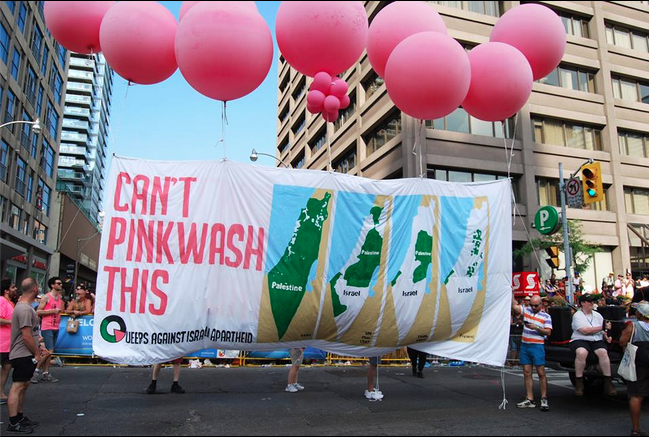
The following deputations were delivered by members of QuAIA at the May 28 meeting of the Executive
Committee of the City of Toronto on the subject of the new municipal Anti-Discrimination Policy. In
the past year, pro-Israel groups such as B’nai Brith have continued their long-standing campaign to
exclude QuAIA from the Pride Parade by demanding that the new policy explicitly proscribe any
discussion of “Israeli apartheid.” The report on the policy handed to the Executive Committee
on April 9, written by municipal staff and lawyers, made clear that such a provision would be
inappropriate, but the Executive Committee, chaired by mayor Rob Ford, has refused to approve the
policy, instead proposing a series of amendments that could be used to stifle criticism of Israel.
City Council will vote on the issue at its upcoming meeting on June 11 and 12.
Elle Flanders
I speak before you today as a member of the Toronto lesbian and gay community; as the former
executive director of the lesbian and gay film festival; a former board member of Pride Toronto; as
well as a member of the Jewish community. I am also a member of Queers Against Israeli Apartheid. I
have fought for a good part of my life to obtain equal rights —those that allow me to speak before
you as an equal citizen today. As a Jewish woman, I am all too aware of how fragile one’s equality
is—and hence I do not only fight for my own rights but the rights of others as well.
Many QuAIA members are Jewish with roots or implications in what takes place in Israel and Palestine.
Other members are longtime human rights and social justice activists. On these bases—Pride has
always been political and it is not for any one of you, not even councilor Pasternak, to decide
which politics can or cannot be at Pride.
My grandparents helped establish the State of Israel councilors. I grew up in Jerusalem. I am neither
self-hating nor deluded. I have spent most of my adult life shadowed by and hence making films about
the conflict in Israel and Palestine. Israel is a state like any other, with flaws, like many
others. Israel is not a sacred cow and is not above critique. There is NOTHING inherently hurtful,
hateful, anti- Semitic, or any other words that have been carelessly bandied about in the face of a
critique of Israeli state policy.
The words Israeli Apartheid are nothing more than a descriptor of systemic racist policies that one
ruling ethnic group has imposed on another in the same land. I grew up in Israel, I think I have
some authority and knowledge to tell you a little bit about what is happening there. It saddens me.
This was my grandparent’s and parent’s dream, a land they help to build. But in that dream, others
were dispossessed. And in that dispossession, much injustice has occurred. I am not afraid to say
that, I am not afraid to admit when I and/or my people have erred. And Israel has indeed erred.
In 2009, I lived in the West Bank for a year, yes, a nice Jewish lesbian living in Ramallah. My
partner and I traveled every day for six months on a segregated road system; they are known as the
apartheid roads because they are segregated by your ethnic identity. Roads for Jewish Israelis,
roads for Palestinians. We made a film about these roads that screened at TIFF 2011. Yes, a film
about the apartheid roads that thousands of people saw at TIFF. You cannot single out Pride,
Councilor Pasternak.
The Israel Supreme Court heard a case arguing that the road systems constituted a state of
apartheid—The term is used in Israeli newspapers and by many Israeli politicians. Just in the last
few months, countless articles appeared in the Israeli press citing Israeli Apartheid. Are they too
creating “atmospheres of discrimination (or hurt)”? Are you suggesting that Toronto knows more about
Israeli Apartheid than Israel?
While there are voices from individuals in the Toronto Jewish community who may claim this hurtful, I
too am the Toronto Jewish community. And I say otherwise.
Enough is enough. Council’s cannot continue to single Pride out. This must end here and now. Your
city staff has said so and Pride’s Dispute Resolution Committee has said so.
Perhaps if councilor Pasternak and those who find the term Israeli Apartheid hurtful, could see the
real effects of these insidious policies, perhaps just then, they would help us all move to peace,
and not apartheid.
Niko Block
What I’d like to talk about here is the politics of the closet versus the politics of pride, so I’ll
begin by coming out of the closet to this committee in a couple of different ways.
The first thing that I’d like to tell you about myself is that I was born in Toronto and raised
largely within the queer community of this city.
The second thing I’d like to disclose is that I have been in long-term relationships and casual
sexual relationships with both men and women. For several years I was confused as to how to
sexually identify, but I eventually came to identify as a queer myself. As an identity, queerness
encompasses an expression of human solidarity, as well as a critique of heteronormativity,
patriarchy, and other forms of oppression. Queerness is, in fact, the very ideology that has allowed
me to feel comfortable exploring my sexual feelings toward other men.
The third thing is that I am Jewish, and half-Israeli. Five years ago, I traveled to Israel and
to the West Bank, where I lived for half a year. That experience significantly altered my perception
of the Israeli-Palestinian conflict, as well as historical processes of colonialism more generally,
and since then I have seldom revealed to an acquaintance that I am Jewish without also adding that I
am an anti-Zionist.
What I am saying here is that being a queer who is against Israeli apartheid is a fundamental part of
who I am. It sounds incredibly naive to me when I hear anyone assert that Pride is not a political
event, because my ability to express my identity as a queer is just as important to me as my ability
to express my identity as a Jewish anti-Zionist. The rhetoric of groups such as B’nai Brith purports
to encourage us to come out of the closet as non-heterosexuals, but simultaneously refuses to allow
us to come out of the closet as members of the left. Those identities to me are inextricable.
Pride became a major institution in Toronto amidst one of the largest health crises our city has ever
faced. Between 1993 and 1998, over 7,300 Canadians died as a result of AIDS, and one quarter of
those deaths took place here in Toronto.
As this crisis hit, it soon became obvious that the culture of shame that dominated at the time was
killing people; it was killing the queer community, it was killing our friends and members of our
families. Multiple studies and historical assessments of the AIDS crisis have demonstrated that at
an institutional level, homophobia exacerbated the AIDS crisis. The government and the medical
establishment were slow to react, and carriers of the infection were stigmatized due to its
association with the gay community.
I see that as a relatively straightforward example of how the culture of the closet can kill people,
and I’d like to propose to the committee that Pride is not simply about throwing a party in the
street, or about bringing money into the city, or about getting wasted and getting laid. To some of
us, Pride is also about saving lives.
Since 2005, 3,400 Palestinians have been killed by Israel, while 125 Israelis have been killed by
Palestinians. That means that in the past 8 years, over 96% of the deaths in the region have been
Palestinian.
I have never met a single soul who has visited West Bank cities like Nablus and Hebron and Jenin and
still refuses to believe that Israel’s policies toward Palestinians are responsible for the ongoing
death in that region. Indeed, as a result of those policies, Palestinians do not have a state, and
they are therefore denied access to the rights of citizenship.
During my time there, I met Palestinian children who have been permanently disabled and disfigured by
Israeli bullets; I met multiple young men who had been imprisoned for years simply for demonstrating
in the streets. It is well documented that throughout its history, Israel has detained hundreds of
thousands of Palestinians without charge or fair trial, and that it continues to use torture
systematically against these detainees, some of them as young as 12. Some Palestinians in Israeli
prisons have in fact been tortured and beaten to death, and these deaths are ongoing.
That Canada is complicit in these acts of violence is a source of shame and frustration for me, but I
do have faith that if enough of us are fully allowed to express ourselves and have the patience to
understand each other – if enough of us, in other words, are allowed to come entirely out of the
closet – then we might be able to improve the situation there. We are simply demanding that we be
allowed to talk freely about the issues that matter to us today, because they are a matter of life
and death and because we remain hopeful that things will improve if we express enough understanding
toward one another.